Tag: Telecaster

  • House Of Tone WideOnes – Pickup Review

    In this review, we’re going to take a look at the House of Tone WideOnes, which are wide-range humbucking pickups built in the United Kingdom. I tested these pickups using a home-built Telecaster with a Warmoth alder body with F-holes & a maple Pau Ferro neck. I played the same exact 30-second riff in a number of contexts: straight into a clean amp, through a Vemuram Jan Ray with very light gain, and with a Wampler Moxie in high-gain mode. The amplifier I played through is a MusicMan RD-50 through a Universal Audio OX.

    Unboxing

    I purchased these directly from House of Tone. Matt Bascetta was super helpful with setting up my order, and shipping to the United States was a breeze. The pickups arrived in perfect condition and came in the gorgeous wood box you see pictured above. First class all the way.

    Construction

    I found the construction of these pickups to be flawless. The word “sturdy” would be an understatement. The adjustable pole pieces were easy to raise and lower, yet not flimsy or likely to go down on their own. I requested a raw nickel finish on these and was very pleased with that choice. Extra mounting screws were included with my order, which I thought was a nice touch, considering that wide-range pickups require twice as many screws as typical humbuckers.

    How Do the WideOnes Sound?

    The bridge pickup had an undeniable twang to it, but I would not go so far as to say that it steps over the line into “Tele” territory. But there is no doubt that it leans away from your typical “macho” bridge humbucker and lands nicely in the “solid yet snappy” range of tone. For surf-rock style playing, this one is a no-brainer. There’s more than meets the eye, though – when I cranked up my overdrive pedal, I was pleasantly surprised at how well this pickup held its own. Anything in the range of blues, classic rock, funk, or pop would be an absolute breeze.
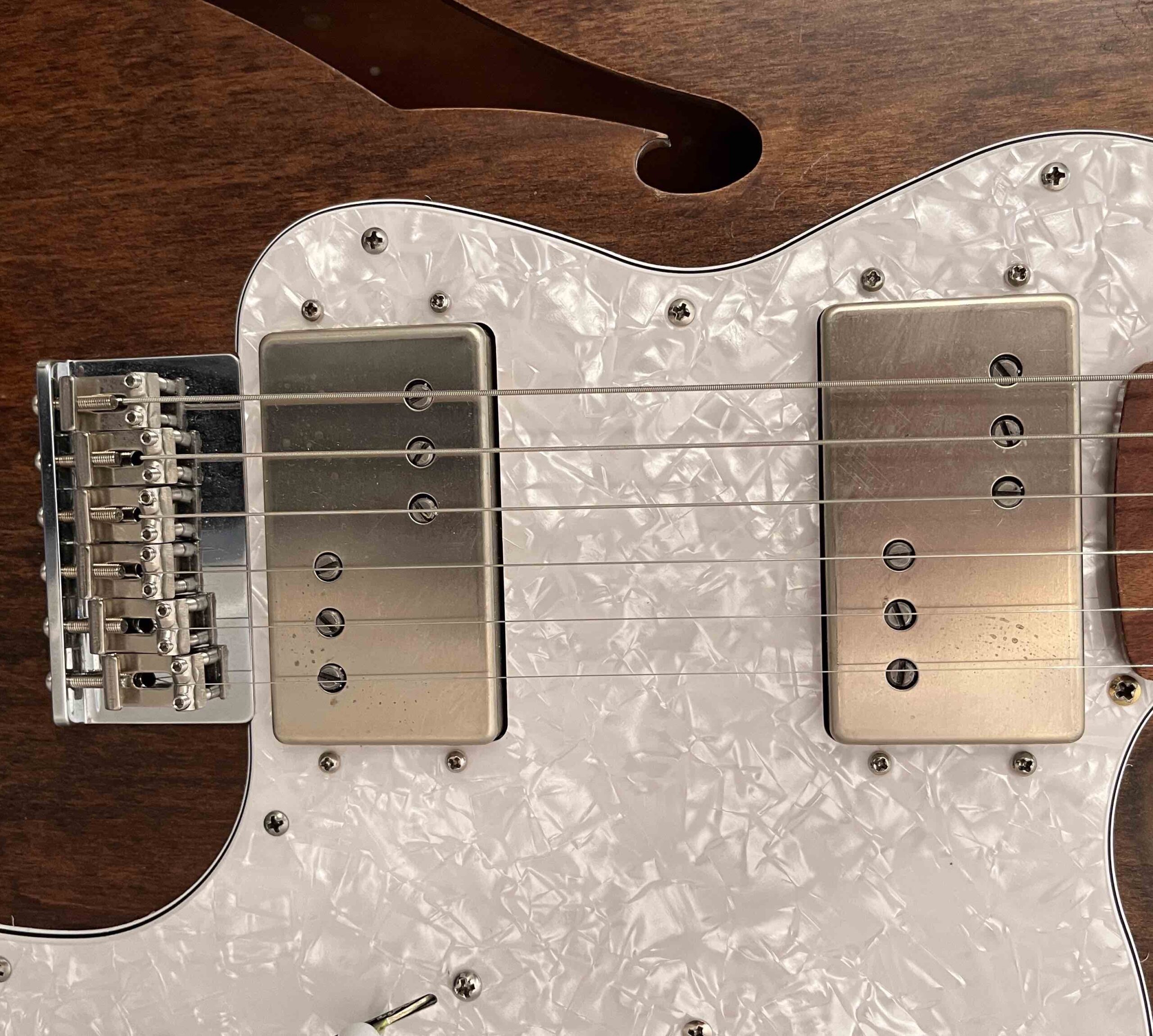

    The neck pickup was so bouncy and playful that I almost couldn’t put my guitar down. Like the bridge pickup, there is plenty of single-coil, bell-like charm. But the Wide One neck position has a “bigness” to it that really stood out. Clean tones were full and alive, but overdrive was like a welcome friend with gobs of tone oozing out of the speakers. From warm & fat to juicy & Stratty, it was all there. When I finally stopped playing, I felt like I had ice cream all over my shirt.

    The one word that kept popping up in my mind with the House of Tone WideOnes was “clarity”. Whether I was going straight into the amp, using light breakup or tons of drive, the clarity of these pickups was impressive.

    Volume Knob Rollback

    I tested this set while using the Lindy Fralin Volume Kit. With the volume knob rolled down the bridge pickup was pretty bright, which is to be expected. This is a sound that would be perfect for a James Brown type of funk, surf or a range of pop styles. With the neck pickup, there was a plethora of usable sounds. Nearly the entire travel of the volume knob yielded a beautifully crisp and sparkly tone.

    Summary

    They say you only get one chance to make a first impression. Well, this was an outstanding first impression. I could not have made a better choice with my first set of pickups from House of Tone. Now I am of course wracked with curiosity and want to try more of their products. Considering the outstanding tone of the WideOnes, and all the positive feedback I’ve come across about House of Tone, I have no doubt that my second impression will be as good as my first.

    How to Contact House Of Tone Pickups

    houseoftonepickups@gmail.com
    Tel: +44 (0)779 169 1251
    Mail:
    House Of Tone Pickups
    96 Northgate St.
    Chester
    CH1 2HT United Kingdom

    Helpful Links

    House of Tone Pickups
    House of Tone WideOnes

  • DiMarzio Super Distortion T Review (DP318)

    When I dropped the DiMarzio Super Distortion T into my Tele’s bridge slot, I wasn’t expecting a time machine back to a late‑’70s Les Paul, and I think that is the best expectation to set for yourself. A single‑coil‑sized, twin‑blade humbucker is never going to be a 1:1 clone of a full‑size Super Distortion—but it absolutely can push a Tele into rock territory without tearing up the guitar. After living with it for a bit, here’s how it really lands in the mix, day to day.

    What the DiMarzio Super Distortion T (DP318) Is — and What It Isn’t

    The Super Distortion T (model DP318) has been around since 2005, and it’s built for the Tele bridge route. It’s a rail hum‑canceling design with a ceramic magnet, four‑conductor wiring, and proper wax potting to keep things quiet when the gain gets real. Output is hot, the voicing is thick, and everything about it says “make the amp work.” If you’re expecting country‑bright sparkle out of this DiMarzio pickup, that’s not the way things are going to go—you install this for blues, rock, and heavier detours.

    How the DiMarzio Super Distortion T Feels in a Tele

    The twin‑blade layout is a practical win on a Tele bridge. Bends stay even across the strings, there are no “fall‑off a pole piece” dead spots, and the overall string‑to‑string balance is better than many staggered‑pole setups. The hum is gone—zero—that matters more than ever once you’re stacking drive and compression. Installation is straightforward, and with the 4‑conductor lead (a DP318 hallmark) you’ve got options for series/parallel and coil‑split wiring if you want more colors on the palette.

    DiMarzio Super Distortion T Tone: Clean to Mean

    At low gain, it’s tidy and bold. You won’t mistake it for a vintage single coil, but chords stay readable and you can keep cleans honest by not overloading the bass on your amp. Roll into edge‑of‑breakup and the Super Distortion T starts to show its personality: mids come forward, the top end smooths out, and there’s a satisfying “push” that makes smaller amps feel bigger than they are.

    Overdrive & Distortion

    Kick on a medium‑gain overdrive or lean into amp crunch and this pickup wakes up. Single‑note lines have sustain, palm‑mutes hit with authority, and the low mids carry riffs without getting flubby (assuming your bass knob isn’t dimed). If you live on classic rock rhythms, heavier blues, punk, or alt‑rock, it feels right at home.

    Coil‑Split & Parallel on the Super Distortion T

    Split and parallel settings are a nice bonus with the 4‑conductor lead. Split mode gets leaner and a bit more Tele‑adjacent, but it’s not a postcard from Bakersfield. Parallel keeps the hum‑canceling and gives you a lighter, snappier option for cleaner parts. I used both as “seasoning,” but the magic here is full humbucking series mode.

    Reality Check vs. a Full‑Size Super Distortion

    Simple physics still applies: you won’t perfectly duplicate a full‑size humbucker in a Tele bridge slot. The DiMarzio Super Distortion T doesn’t pretend otherwise. It’s tighter on the low end, the treble is smoother and less “bitey,” and the midrange push is where the action is. If your goal is to keep a Tele looking like a Tele while giving it the muscle to hang with bigger guitars, the DP318 is exactly that move.

    DiMarzio Super Distortion T Use Cases (Where It Shines—and Where It Doesn’t)

    • Great for: Rock, blues, hard rock, punk/alt‑rock; driving medium‑gain tube amps; taming single‑coil noise without losing attack.
    • Good for: Drop‑D riffs and chunky rhythm parts where you want tight lows without mud.
    • Not the best for: Ultra‑clean, ultra‑bright Tele sparkle or pure vintage twang; jazz clean with huge headroom.

    DiMarzio Super Distortion T Pricing in the Real World

    The official list price is $109. On the open market—Reverb, eBay, the occasional Amazon listing—you’ll often see the Super Distortion T going for a few bucks under list, depending on the condition. If you’re patient, you might be able to snag it for closer to $75 without a box or screws.

    Personal Takeaways on the Super Distortion T

    • If you expect a Tele to magically morph into a mahogany single‑cut, you’ll be disappointed. If you want a Tele that can actually rock—without routing or swapping the bridge—DP318 will get you there.
    • It’s noticeably more than twice the output of a traditional Tele bridge, but it still responds well to pick dynamics and volume‑knob cleanup.
    • The “feel” upgrade is real: the rail design makes bends and wide vibrato feel more even and controlled.
    • Zero hum at high gain is worth its weight in gold on noisy stages or under bright studio lights.

    Summary

    If your Tele needs teeth, the DiMarzio Super Distortion T does what it says on the tin. It’s a hot, husky, hum‑canceling bridge pickup that keeps the guitar looking stock while steering the tone toward thick mids, tight lows, and smooth top end. Split and parallel modes add useful flavors, but full‑series humbucking is where it sings. It won’t replace a full‑size Super Distortion one‑for‑one, and that’s fine—the Super Distortion T stands on its own as a fast, reliable way to make a Tele carry the rock gig with the kind of muscle you need.

    DiMarzio Super Distortion T Specs & Pricing

    • Model: DiMarzio Super Distortion T — DP318
    • Year Introduced: 2005
    • Magnet: Ceramic
    • DC Resistance (bridge): 13.18 kΩ
    • Wiring: 4‑conductor (series / split / parallel capable)
    • Potting: Wax potted
    • Cover / Color Options: Black, White, Aged White, Cream, Yellow, Red, Pink, Purple, Blue, Green, Mint Green, Chrome, Gold
    • Retail (list) price: Typically around $109
    • Typical street price: Often ~ $95 depending on condition